
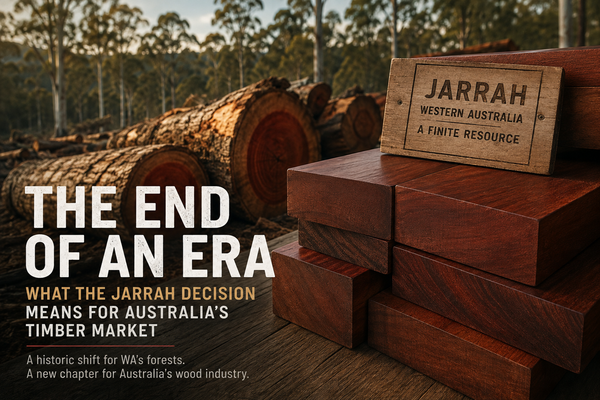
The End of an Era: What the Jarrah Decision Means for Australia’s Timber Market

The End of an Era: What the Jarrah Decision Means for Australia’s Timber Market
Western Australia’s decision to end large-scale commercial harvesting of its native forests has fundamentally changed the future of one of Australia’s most recognisable hardwoods. For woodworkers, furniture makers, flooring manufacturers and timber suppliers, the question is no longer whether jarrah will become harder to obtain — it is what happens to the market when a timber that has been commercially available for generations becomes a finite resource.
There are few Australian timbers as immediately recognisable as jarrah.
Its deep red-brown colour, interlocking grain, exceptional durability and ability to take a beautiful finish have made Eucalyptus marginata a favourite for furniture, flooring, cabinetry, joinery, decking and countless specialist woodworking applications.
For generations, Western Australia's jarrah forests supplied a commercial timber industry that became part of the state's industrial identity.
That era has now ended.
On 1 January 2024, Western Australia brought its new Forest Management Plan 2024–2033 into effect, ending large-scale commercial timber harvesting in the state's native forests. The policy applies to the native forests of the south-west, including the jarrah and karri forests. In June 2025, legislation was passed giving legal effect to the government's decision to end large-scale commercial harvesting.
For the Australian woodworking industry, however, this is more than an environmental or political story.
It is a supply-chain story.
And the consequences are likely to be felt for decades.
A timber supply has become a finite resource
The most important distinction is that the decision did not make jarrah illegal.
Jarrah timber can still enter the market through existing stocks, recycled and reclaimed timber, salvage and the limited native timber that may become available through ecological thinning and other permitted activities under the new management framework. The Forest Management Plan specifically allows native timber to be made available through ecological thinning intended to improve forest health and resilience.
What has disappeared is the previous model of large-scale commercial harvesting.
That distinction matters enormously.
A functioning timber industry normally relies on a predictable flow of logs from forest to sawmill, from sawmill to merchant and ultimately to the workshop. Remove the first stage and the rest of the supply chain has to adapt.
The jarrah market is therefore moving from a production market to a scarcity market.
Instead of asking, "How much jarrah can we produce?", the industry increasingly has to ask, "How much jarrah already exists, where is it, and how efficiently can we use it?"
That is a very different economic model.
The price signal arrived early
There is already evidence of what happens when the market anticipates a permanent reduction in supply.
When the WA Government announced in 2021 that native forest harvesting would cease, the ABC reported that jarrah prices had already risen by approximately 60 per cent, with furniture manufacturers warning that the price of locally made jarrah and marri products would increase.
That was before the shutdown actually occurred.
The significance for today's market is obvious: the supply constraint was being priced into the market years before the last conventional harvesting operations ended.
Since January 2024, the situation has become structural rather than speculative.
Jarrah is no longer simply a timber that happens to be expensive. It is a timber for which the underlying supply of newly harvested commercial logs has fundamentally changed.
That distinction will become increasingly important as existing stocks are consumed.
What happens to the Australian woodworker?
For the professional woodworker, the impact will not necessarily be immediate.
There is still jarrah in Australia.
There are substantial quantities of sawn timber already sitting in merchants' yards, workshops, private collections and commercial inventories. There is also a significant secondary resource in buildings, old flooring, demolition timber, railway sleepers and other structures.
This creates an interesting paradox.
Australia may have less new jarrah available while simultaneously having millions of pieces of old jarrah already in circulation.
For woodworkers, that creates an opportunity.
Reclaimed jarrah is likely to become increasingly important, particularly for high-value furniture and architectural work. Old jarrah can also possess characteristics that are extremely attractive to craftsmen: mature colour, weathering, distinctive grain and, in some cases, dimensions that are difficult to obtain from modern production timber.
The challenge will be consistency.
A merchant accustomed to ordering a particular grade, thickness and quantity of new jarrah cannot necessarily replace that supply with reclaimed material. Reclaimed boards vary enormously in dimensions, moisture history, defects, nail holes, coatings and previous use.
For a one-off furniture maker, that can be part of the appeal.
For a manufacturer producing 500 identical tables, it is a serious problem.
The biggest impact may be on manufacturing
The Australian furniture industry is particularly exposed because jarrah's appeal is not simply technical.
It is cultural.
A Perth-made dining table marketed as being constructed from Western Australian jarrah is selling more than a set of physical properties. It is selling provenance.
That makes substitution difficult.
Blackbutt, spotted gum, ironbark and other Australian hardwoods can provide excellent technical alternatives for many applications, but they do not look like jarrah and they do not carry the same Western Australian identity.
For manufacturers, there are therefore three broad strategies:
Use less jarrah.
This means incorporating jarrah as an accent rather than making an entire product from it.
Substitute another Australian hardwood.
This preserves the Australian-made and Australian-timber story, although the visual result changes.
Move upmarket.
Instead of competing on volume, manufacturers can use jarrah where its scarcity and provenance become part of the product's value.
The third strategy may ultimately be the most interesting.
A scarce Australian hardwood could become analogous to other premium natural materials: something specified carefully, documented and used where its characteristics justify the cost.
The rise of the "heritage timber"
There is another consequence that deserves more attention.
Jarrah may gradually stop being viewed as an ordinary commercial hardwood and start being treated as a heritage material.
We have seen similar transitions with old-growth timbers in other markets.
Once a species becomes difficult to source conventionally, the provenance of the material becomes increasingly important.
A piece of jarrah recovered from a 100-year-old building could eventually be worth considerably more than an equivalent piece of generic new timber — not because the wood itself has magically changed, but because its history has become part of its value.
That presents an opportunity for demolition contractors, salvage operators, architectural salvage businesses, timber recyclers and specialist merchants.
It also creates a responsibility.
Reclaimed jarrah needs to be properly identified, graded and represented. As prices rise, the incentive to misrepresent another hardwood as jarrah will also increase.
For buyers, provenance and traceability will become increasingly important.
Australia will need substitutes
The end of large-scale native harvesting in WA does not mean Australians will stop wanting hardwood.
The demand remains.
Flooring still needs to be manufactured. Furniture makers still need durable timber. Builders still need decking and joinery materials. Cabinetmakers and woodworkers will continue looking for attractive Australian species.
That demand has to go somewhere.
Some will move to other Australian hardwoods such as blackbutt, spotted gum, ironbark and other species sourced from regions where commercial harvesting remains permitted.
Some will move toward plantation-grown timber.
Some will move toward imported hardwoods.
And some will simply use less solid timber.
The substitution effect is already visible. In 2021, the ABC reported that WA furniture manufacturers were investigating Indonesian hardwoods as alternatives to jarrah and other native timbers as local supplies tightened.
That creates a particularly interesting issue for Australian consumers.
A policy designed to protect native forests can have the unintended market consequence of increasing Australia's reliance on imported timber unless domestic alternatives are developed at sufficient scale.
That does not make the policy right or wrong.
It simply means the environmental equation does not end at the forest boundary.
Imported timber brings its own responsibilities
For Australian woodworkers, importing hardwood is not as simple as finding a species with a similar colour and hardness.
Australia has biosecurity requirements for imported timber and timber products, and importers may also have obligations relating to illegally logged timber and due diligence.
This matters because one of the central arguments for replacing native hardwood with imported timber is sustainability.
A timber cannot automatically be considered a better environmental choice simply because it wasn't harvested in Australia.
The question has to be:
Where did it come from, how was it harvested, how was it processed and transported, and can its legality and provenance be demonstrated?
For professional workshops and manufacturers, responsible sourcing will increasingly become part of product specification rather than an optional marketing statement.
The plantation question
The WA Government has committed significant investment to softwood plantations as part of the transition away from native forest harvesting. The government announced a $350 million investment in WA's softwood plantation industry, arguing that the plantation sector would support jobs and future timber supply.
But softwood plantations cannot simply replace jarrah.
They serve different markets.
A radiata pine framing product is not a direct substitute for a dense, durable jarrah component in a piece of high-end outdoor furniture.
Nor can a plantation hardwood instantly reproduce the supply characteristics of mature jarrah.
Hardwood is particularly complicated because many of the characteristics valued by woodworkers — density, stability, colour, grain structure and mature heartwood — are products of long growth periods.
The old forestry industry therefore cannot simply be replaced with a new plantation industry overnight.
The transition is measured in decades.
The Australian market could become more regional
One likely consequence is a greater differentiation between Australian hardwood markets.
Eastern Australian manufacturers may increasingly rely on species such as blackbutt, spotted gum and ironbark.
Western Australian manufacturers will have access to a smaller and increasingly specialised jarrah resource alongside other local materials.
Jarrah itself may become disproportionately expensive outside WA because transport is being added to an already constrained supply.
This could create a curious reversal.
For much of its commercial history, jarrah was simply "WA timber."
In the future, a genuine piece of Western Australian jarrah may become a premium national product.
The further it travels from its source, the more its scarcity and provenance may influence its price.
What does this mean for timber merchants?
Merchants are likely to become increasingly important in managing the transition.
Stockholding becomes more valuable when supply is unpredictable.
A merchant holding a significant inventory of high-quality, legally sourced jarrah may effectively be holding an appreciating asset.
But there is a trap here.
Speculation can push a scarce material beyond the point where ordinary woodworking businesses can justify using it.
If jarrah becomes too expensive, manufacturers will redesign around other species.
That creates a self-reinforcing cycle:
scarcity → higher prices → substitution → declining mainstream demand → jarrah becomes increasingly niche.
Once that cycle becomes established, jarrah could move from a mainstream hardwood into the premium and specialist market.
That would be a profound change.
The impact on small workshops
For the small workshop, the picture is less bleak.
In fact, there may be opportunities.
A small furniture maker does not need thousands of tonnes of consistent production timber. They need good boards.
That makes reclaimed timber, salvage and carefully sourced specialty stock viable alternatives.
It also makes efficient timber utilisation more important.
The future jarrah workshop may look very different from the traditional one.
Instead of buying a large quantity of identical boards, the craftsman may purchase a small quantity of exceptional material and design the piece around it.
That favours bespoke furniture, architectural commissions, sculptural work and high-end joinery.
In other words, scarcity may push jarrah up the value chain.
The ecological argument cannot be ignored
Any discussion of the jarrah industry also needs to acknowledge why the policy exists.
The WA Government's Forest Management Plan covers more than 2.5 million hectares of native forest and is intended to protect forest ecosystems while changing the way the state's forests are managed. The government's position is that ending large-scale commercial harvesting will improve protection of native forests, while limited ecological thinning can be used to support forest health and resilience.
The policy has also been strongly supported by conservation organisations, while sections of the forestry and manufacturing industries have argued that sustainable harvesting could continue.
For woodworkers, it is tempting to reduce the debate to "save the forests" versus "save the timber industry."
The reality is considerably more complicated.
Jarrah is simultaneously:
-
an ecological resource;
-
a commercial resource;
-
a cultural symbol of Western Australia;
-
a valuable material for Australian manufacturing;
-
and an increasingly scarce woodworking resource.
All five things can be true at the same time.
The bigger Australian lesson
Western Australia's jarrah decision should be watched closely by everyone involved in Australian woodworking.
It provides a preview of what happens when a mature native timber resource moves from a managed commercial supply to a restricted and finite resource.
The immediate consequence is not that jarrah disappears.
It is that the economics of jarrah change permanently.
The industry will adapt through substitution, recycling, imports, better utilisation, higher-value manufacturing and new plantation resources.
But some things cannot be replaced.
You cannot plant a 100-year-old jarrah forest and harvest it in 20 years.
You cannot manufacture the history of a reclaimed jarrah floor.
And you cannot reproduce the cultural identity of a timber that has been part of Western Australian life for more than a century.
For Australian woodworkers, that means jarrah should perhaps be treated differently from the way it was treated in the past.
Use it carefully.
Buy it responsibly.
Waste as little as possible.
Document its provenance.
And when an exceptional piece comes across the workshop bench, recognise that it may be more than simply another hardwood board.
It may be part of the final chapter of Australia's great jarrah timber industry.
A new role for the woodworker
The end of large-scale jarrah harvesting does not have to mean the end of jarrah woodworking.
It may instead mark the beginning of a different kind of jarrah industry — one based on reclamation, restoration, craftsmanship, provenance and value rather than volume.
That could ultimately be a fitting future for one of Australia's most remarkable timbers.
After all, the measure of a great woodworking material is not how quickly we can consume it.
It is how long we can make it last.
More from the Journal
The End of an Era: What the Jarrah Decision Means for Australia’s Timber Market
Western Australia’s decision to end large-scale commercial harvesting of its native forests marks...
Read article →
The Dust You Can't Afford to Breathe
Wood dust is classed as carcinogenic by the IARC, yet many workshops still treat it as a nuisance...
Read article → acrylic
Making Your First Hand-Turned Wooden or Acrylic Pen
A hand-turned pen is one of the most rewarding projects for new woodturners, combining creativity...
Read article →
Hard Wax Oils in Woodworking: A Modern Finish with Traditional Roots
Hard wax oils have become one of the most popular finishes in modern woodworking, offering a uniq...
Read article → acrylic blanks
Timber vs Acrylic Pen Blanks: How to Choose the Right Material for Your Next Pen
Timber or acrylic? Both make stunning pens — but they turn, finish, and look very differently. He...
Read article →