
The Dust You Can't Afford to Breathe
The Dust You Can't Afford to Breathe
Wood Dust: Risks, Health Effects and Practical Controls for the Workshop
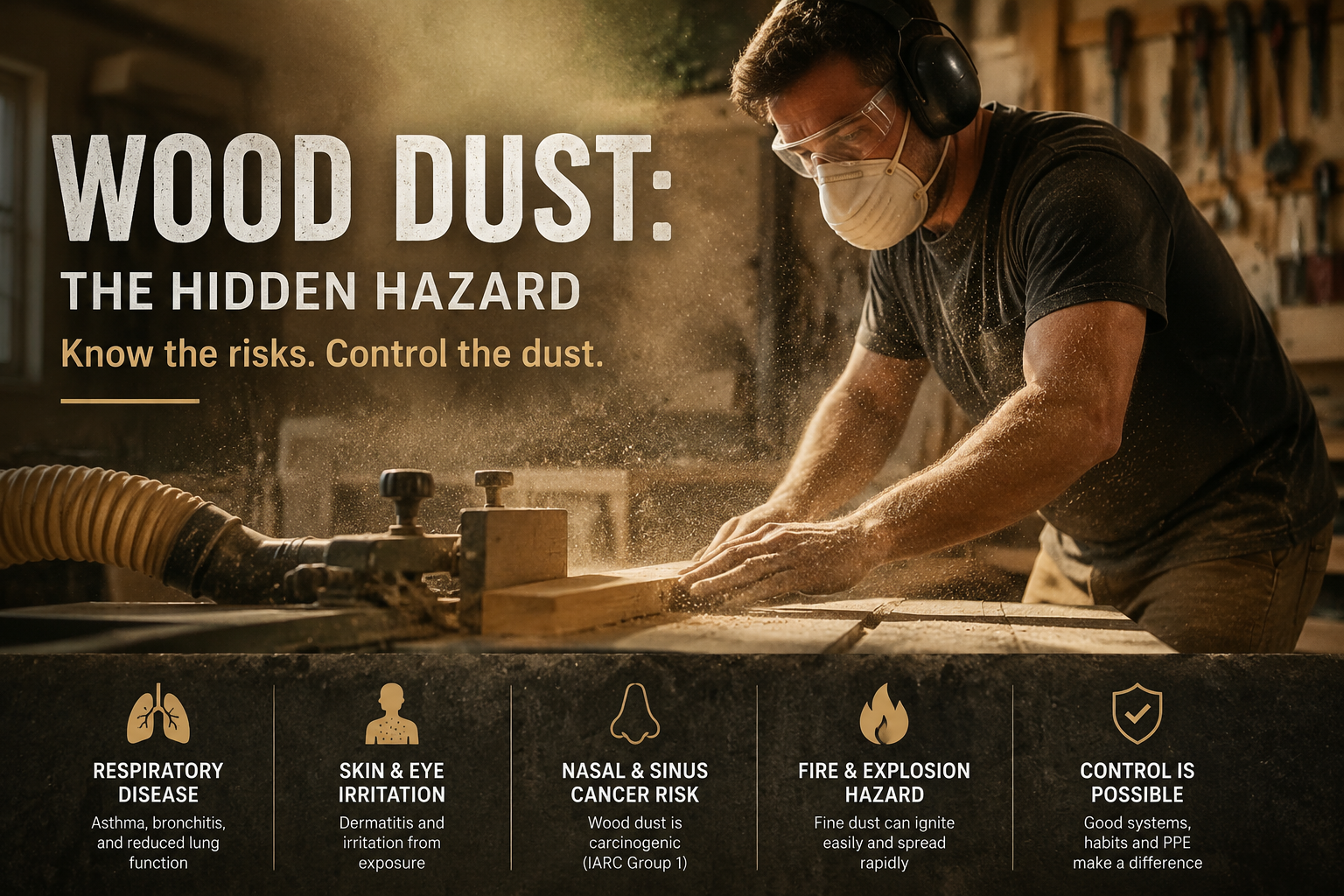
Every woodworker knows the smell of fresh-cut timber, that fine haze hanging in a beam of workshop light. It looks almost pleasant. It isn't. Wood dust is one of the oldest and most under-rated hazards in our trade, and the science on it has become considerably less forgiving over the past three decades.
In 1995 the International Agency for Research on Cancer (IARC) classified wood dust as a Group 1 carcinogen, the same category as asbestos and tobacco smoke, after finding sufficient evidence linking occupational exposure to adenocarcinoma of the nasal cavity and paranasal sinuses. A pooled analysis of twelve case-control studies found workers with the highest cumulative exposure faced a relative risk of nasal adenocarcinoma more than 45 times that of unexposed workers. In 2009, IARC extended its findings to cover cancers of the nasopharynx as well. This is not a fringe finding from a single study; it is the consensus position of the world's leading cancer research body, built on decades of epidemiology in furniture makers, cabinetmakers and sawmill workers.
For a working joiner or cabinetmaker, that's a sobering thing to sit with. But the cancer risk is only part of the picture, and arguably not even the part most likely to affect you day to day.
What wood dust actually does to a body
Inhalable wood dust particles are small enough to be drawn into the nose and mouth and travel into the upper respiratory tract; the finer, respirable fraction penetrates deeper into the lungs. WorkSafe New Zealand and Safe Work Australia both note that sawing, shaping and sanding are the dustiest operations in a workshop, with sanding manufactured boards such as MDF producing especially high concentrations of fine dust.
The health effects break down into several distinct categories, and it is worth being precise about them rather than lumping everything under “dust is bad for you”:
• Respiratory sensitisation and asthma — Certain species, particularly western red cedar, are potent respiratory sensitisers. Once a worker becomes sensitised, subsequent exposure to even very low concentrations can trigger severe asthma attacks. This is why western red cedar carries its own, much stricter exposure limit in several jurisdictions rather than being treated as generic softwood dust.
• Chronic bronchitis and reduced lung function — Long-term exposure, even at moderate levels, is associated with chronic bronchitis, reduced lung capacity and hypersensitivity pneumonitis, an inflammatory reaction in the lung tissue itself.
• Dermatitis and contact allergy — Resins, tannins and other extractives in wood sap are skin irritants and allergens in their own right. Contact dermatitis is common among people who handle raw and freshly milled timber daily, and repeated exposure can lead to sensitisation that makes even brief contact painful.
• Nasal and sinus cancer — As outlined above, this is the effect with the strongest and most specific evidence, and it is now firmly established rather than merely suspected.
There is an additional, non-health hazard that deserves a place in this discussion because it kills people just as certainly: fire and explosion. Fine wood dust is a combustible dust. The U.S. National Fire Protection Association has noted that a dust layer as thin as 1/32 of an inch, roughly the thickness of a coin, covering just 5% of a room's surface can fuel a catastrophic explosion if disturbed and ignited, and a secondary blast triggered by a first, smaller ignition is frequently the more destructive event. Any workshop that lets dust accumulate on rafters, ledges and dust collector housings is carrying more risk than most owners realise.
What “safe” actually means, and why the numbers vary
Workplace exposure standards for wood dust differ by species, by country, and periodically by revision, which causes genuine confusion on the shop floor. As a guide, current standards include:
• Australia — Safe Work Australia sets a workplace exposure standard of 1 mg/m³ (8-hour time-weighted average, inhalable fraction) for hardwood dusts such as oak, beech, jarrah, blackbutt and spotted gum, and 5 mg/m³ for softwood dust, with a 10 mg/m³ short-term exposure limit for softwood.
• New Zealand — WorkSafe applies an interim exposure standard of 2 mg/m³ for softwood dust, and treats hardwood dust as the higher-risk category, though it recommends managing all wood dust, including composites like MDF and particleboard, as hazardous regardless of species.
• United Kingdom — The Health and Safety Executive sets workplace exposure limits of 3 mg/m³ for hardwood dust and 5 mg/m³ for softwood dust.
• United States — OSHA's permissible exposure limit sits at a comparatively lax 15 mg/m³ total dust (5 mg/m³ respirable), though it drops to 2.5 mg/m³ specifically for western red cedar because of its asthma-inducing properties. NIOSH and the American Conference of Governmental Industrial Hygienists both recommend a considerably stricter 1 mg/m³ across the board, arguing the OSHA figure is outdated and does not reflect current health evidence.
The takeaway for a working shop: don't treat the legal limit as a target. It is a ceiling, set decades ago in some jurisdictions, and the trend across every regulator is downward as the science matures. Good practice means aiming well below the number on the compliance sheet.
Controlling the risk: what actually works
The control measures that matter are not novel and none of them require guesswork; they follow the standard hierarchy of controls, and the order matters because each rung is markedly more reliable than the one below it.
Elimination and substitution sit at the top. Buying pre-cut, pre-sanded or pre-finished components shifts dust generation off your premises entirely. It's not always practical for a working shop, but it is worth asking, for any repetitive high-dust operation, whether it can be outsourced or bought in finished.
Engineering controls come next, and this is where most of the real-world protection happens. Local exhaust ventilation (LEV) — fixed extraction hoods positioned as close as possible to the point of dust generation on every saw, sander, planer, router and moulder — is the primary and most effective control available. Portable power tools should be paired with on-tool extraction and an M-Class or H-Class rated vacuum, not a shop-vac pulled off the shelf. LEV systems are only as good as their maintenance: ducting, filters and collector bins need regular inspection, and a system that has silently lost suction is worse than none at all because it creates a false sense of security.
Good housekeeping is an engineering and administrative control in its own right. Dry sweeping with a broom simply re-suspends fine dust into the air you're about to breathe. Vacuum with an appropriately rated extractor, and keep horizontal surfaces, rafters and ledges clear given the fire risk outlined above.
Administrative controls — rotating workers away from the dustiest tasks, scheduling high-dust operations for times when fewer people are in the shop, and training staff to recognise when extraction isn't working — reduce exposure duration even where engineering controls can't eliminate dust entirely.
Respiratory protective equipment (RPE) sits deliberately at the bottom of the hierarchy, not because it doesn't matter but because it is the least reliable control on the list. Studies cited by health and safety regulators suggest roughly half of respirators in field use fail to deliver their rated protection factor because of poor fit, lack of training or inadequate maintenance. RPE has a real place — for short-duration jobs like cleaning out a dust collector, or as backup while an LEV fault is repaired — but it should never be the primary line of defence in a workshop that runs dusty operations day in, day out.
The bottom line
Wood dust is not an inevitable cost of doing the work you love. The evidence for its harm is settled science, not scaremongering, and the controls that reduce it are well understood, affordable relative to the alternative, and used successfully in workshops of every size across Australia and New Zealand. The shops that get this right treat dust extraction the same way they treat a sharp blade or a functioning guard: as basic equipment, not an optional extra. Your lungs, and everyone else's in the shop, will not get a second chance to make up for the years you skipped it.
Sources
International Agency for Research on Cancer (IARC), Monographs on the Evaluation of Carcinogenic Risks to Humans — Wood Dust.
Safe Work Australia, Workplace Exposure Standards for Airborne Contaminants.
WorkSafe New Zealand, “Wood dust: controlling the risks” and Workplace Exposure Standards and Biological Exposure Indices (14th edition).
UK Health and Safety Executive (HSE), wood dust guidance and Research Report RR1211.
US Occupational Safety and Health Administration (OSHA), Woodworking eTool.
National Institute for Occupational Safety and Health (NIOSH), 1988 PEL Project — Wood Dust.
National Fire Protection Association (NFPA), combustible dust guidance.
More from the Journal
The Dust You Can't Afford to Breathe
Wood dust is classed as carcinogenic by the IARC, yet many workshops still treat it as a nuisance...
Read article → acrylic
Making Your First Hand-Turned Wooden or Acrylic Pen
A hand-turned pen is one of the most rewarding projects for new woodturners, combining creativity...
Read article →
Hard Wax Oils in Woodworking: A Modern Finish with Traditional Roots
Hard wax oils have become one of the most popular finishes in modern woodworking, offering a uniq...
Read article → acrylic blanks
Timber vs Acrylic Pen Blanks: How to Choose the Right Material for Your Next Pen
Timber or acrylic? Both make stunning pens — but they turn, finish, and look very differently. He...
Read article →