
Timber vs Acrylic Pen Blanks: How to Choose the Right Material for Your Next Pen
Timber vs Acrylic Pen Blanks: How to Choose the Right Material for Your Next Pen
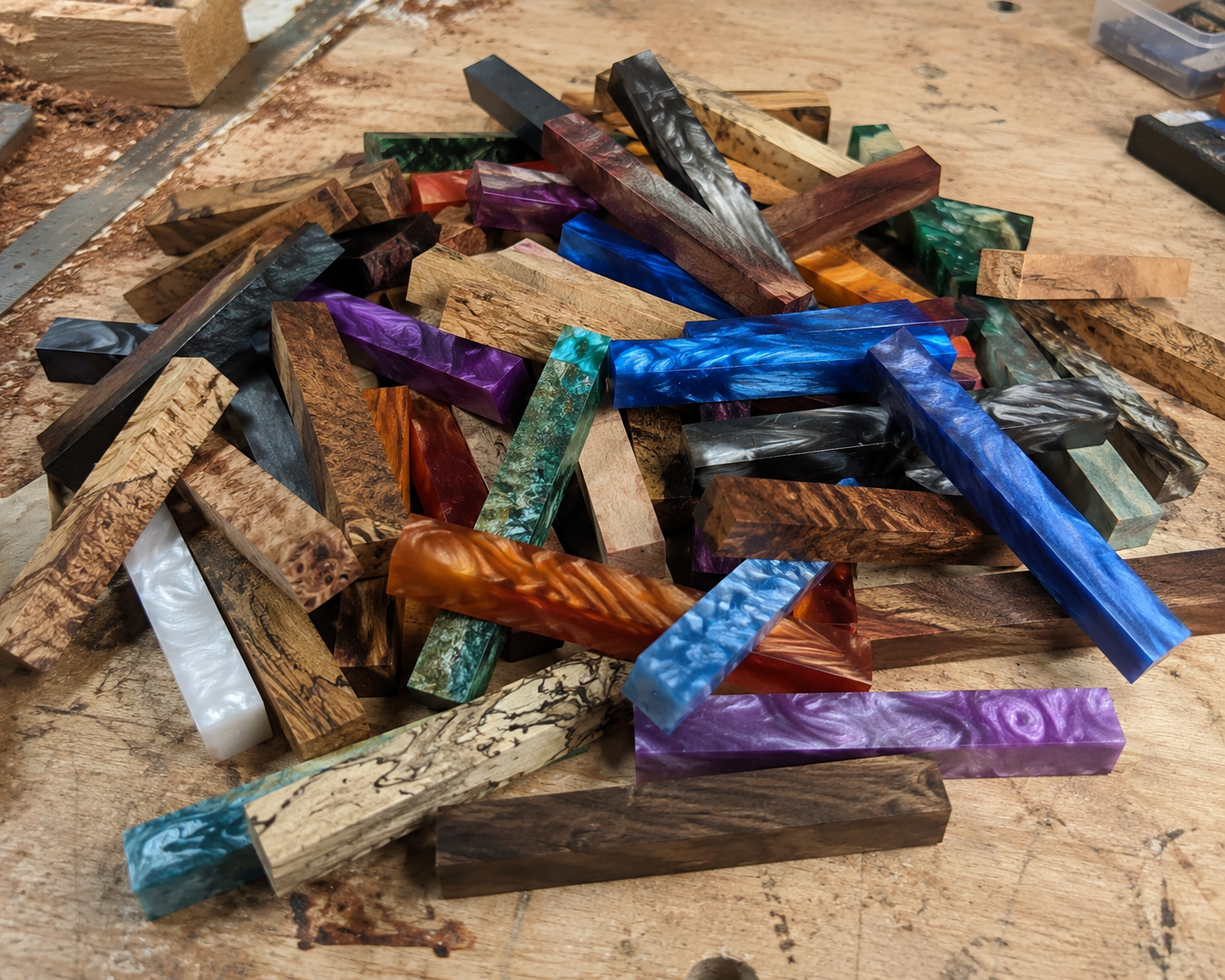
One of the first decisions every pen maker faces is also one of the most enjoyable: timber or acrylic? Both materials produce beautiful, functional pens. Both have devoted fans in the pen turning community. And both have genuine strengths that make them the right choice in different situations.
Understanding the differences — how each material turns, finishes, and looks in the hand — will help you choose the right blank for every project, whether you’re making a gift, building your skills, or expanding your range.
The Case for Timber Pen Blanks
There is something irreplaceable about a pen turned from real timber. The grain, the warmth, the weight, the smell of fresh shavings — timber connects the finished pen to something natural and alive in a way no synthetic material can replicate.
What Makes Timber Special
Every timber blank is unique. Even two blanks cut from the same board will have different grain patterns, figure, and character. This means every timber pen is genuinely one of a kind — something that resonates strongly with buyers and gift recipients alike.
Australian native timbers are particularly prized in the pen turning world. Jarrah, blackwood, huon pine, silver ash, and Queensland maple all produce pens with extraordinary grain and colour that simply cannot be found anywhere else in the world. These timbers carry a story — of place, of craft, of material that has taken decades to grow.
Turning Timber
Timber turns intuitively. Most woodturners find it easier to read and respond to than acrylic — the tool feedback is familiar, the shavings are satisfying, and the material is forgiving of minor technique variations.
Denser timbers like jarrah, rosewood, and ebony turn cleanly with sharp tools and produce a fine surface straight off the tool. Softer or more open-grained timbers may require more careful sanding to achieve a smooth result.
Finishing Timber Pens
Timber pens can be finished with a wide range of products — CA glue finishes, friction polish, hard wax oils, or specialised pen finishes. Each produces a different look and feel.
For a natural, tactile finish that enhances the grain without creating a plastic-like coating, hard wax oils are an excellent choice. Vinnie’s Oil range is well suited to pen turning — the penetrating formula nourishes the timber and provides durable protection while keeping the surface feeling like real wood.
Timber Considerations
- Natural variation means no two pens are identical — a strength for gifting, a challenge for matching sets
- Some timbers are prone to checking or movement with humidity changes
- Highly figured or burl timbers can be more challenging to turn cleanly
- Grain direction affects both turning behaviour and finished appearance
The Case for Acrylic Pen Blanks
Acrylic pen blanks offer something timber simply cannot: colour. Vivid swirls, marbled patterns, translucent effects, and combinations that look like captured galaxies or ocean waves — acrylic opens up a completely different aesthetic vocabulary for pen makers.
What Makes Acrylic Special
Acrylic blanks are consistent, stable, and predictable. Unlike timber, they won’t move with humidity, check, or surprise you with hidden defects. What you see in the blank is what you’ll get in the finished pen — which makes them excellent for beginners and for production pen making where consistency matters.
The colour possibilities are extraordinary. From subtle two-tone swirls to bold multi-colour patterns, acrylic blanks let you match a pen to a personality, an occasion, or a colour scheme in a way that timber rarely can.
Browse Arborean’s acrylic pen blank range for a selection of vibrant swirl patterns — including deep blue, charcoal and red, black and teal, and green and white combinations.
Turning Acrylic
Acrylic requires a slightly different approach than timber. The key differences:
- Sharp tools are essential — dull tools cause chipping and tearing rather than clean cuts
- Light cuts work better — acrylic doesn’t respond well to aggressive material removal
- Heat is the enemy — friction from blunt tools or excessive speed can melt the surface, leaving marks that are difficult to remove
- Carbide insert tools are popular for acrylic because they maintain a sharp edge without frequent sharpening
Finishing Acrylic Pens
Acrylic doesn’t need a protective finish in the same way timber does — the material itself is durable and moisture-resistant. Instead, finishing acrylic is about polishing: working through progressively finer grits of sandpaper and then micro-mesh or plastic polish to achieve a glass-like shine.
A properly polished acrylic pen is genuinely stunning — the colours appear to glow from within, and the surface has a depth and clarity that rivals commercial pens costing many times more.
Acrylic Considerations
- Requires sharp tools and careful technique to avoid chipping
- Heat build-up from friction can damage the surface
- Polishing takes more time than applying a timber finish
- Less tactile warmth than timber — some buyers prefer the feel of wood
Which Should You Choose?
The honest answer is: both. Most pen turners work with both materials regularly, choosing based on the project, the recipient, and what they feel like making that day.
That said, here are some useful guidelines:
- Choose timber when the pen is a personal gift, when you want something unique and natural, or when the recipient appreciates traditional craftsmanship
- Choose acrylic when you want bold colour, consistency across multiple pens, or a material that’s forgiving of humidity and storage conditions
- Choose timber when you’re pairing with gold hardware — darker timbers and warm gold are a classic combination
- Choose acrylic when you’re pairing with chrome or gunmetal — the cool hardware complements the clarity of polished acrylic beautifully
- Start with acrylic if you’re a beginner — the consistency and predictability make it easier to learn technique without worrying about grain direction or defects
Getting Started
Whether you’re drawn to the warmth of timber or the vibrancy of acrylic, Arborean has what you need to get turning. Browse our acrylic pen blanks, explore our pen making range including kits, mandrels, bushings, and drill bits, and finish your pens beautifully with the Vinnie’s Oil range.
The best pen blank is the one that excites you. Start there.
More from the Journal
 acrylic
Making Your First Hand-Turned Wooden or Acrylic Pen
A hand-turned pen is one of the most rewarding projects for new woodturners, combining creativity...
Read article →
Hard Wax Oils in Woodworking: A Modern Finish with Traditional Roots
Hard wax oils have become one of the most popular finishes in modern woodworking, offering a uniq...
Read article → acrylic blanks
Timber vs Acrylic Pen Blanks: How to Choose the Right Material for Your Next Pen
Timber or acrylic? Both make stunning pens — but they turn, finish, and look very differently. He...
Read article →